

 Saba Khalil

Imagine a master key that could open every single lock in the world, from your diary to the most secure bank vault. That’s the kind of paradigm-shifting power the rise of quantum computing brings to the digital world. It’s not just an incremental upgrade; it’s a fundamental leap that promises to redefine the very foundations of our online security.
While this emerging technology holds incredible potential for breakthroughs in medicine, materials science, and AI, it simultaneously casts a long, unsettling shadow over the field of cybersecurity and data privacy. The very tools that could solve humanity’s greatest challenges also have the power to dismantle our global digital security infrastructure. Let’s unravel what this technological revolution means for the safety of your information today and in the near future.
Beyond Ones and Zeros: A New Type of Machine
To understand the threat, you first need to grasp the opportunity. Our current digital world runs on classical computers that use bits—tiny switches that are either in an “on” state (1) or an “off” state (0). Every app, website, and file is built on this binary language.
Quantum computers are different. They use quantum bits, or qubits. Thanks to the mind-bending laws of quantum mechanics, a qubit can exist as a 1, a 0, or, crucially, both at the same time—a state known as “superposition.” Furthermore, qubits can be “entangled,” meaning the state of one is instantly connected to the state of another, no matter the distance.
This allows quantum computers to perform astronomical numbers of calculations simultaneously. Problems that would take today’s most powerful supercomputers thousands of years to solve could be cracked by a sufficiently advanced quantum machine in mere hours. This incredible power, however, becomes a double-edged sword when aimed at the algorithms that currently keep our data safe.
The Looming Quantum Threat to Encryption
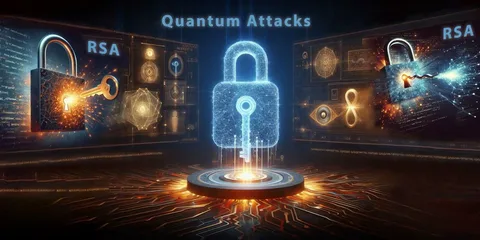
Most of our modern digital security rests on a simple, elegant concept: certain mathematical problems are so complex that they are practically impossible for classical computers to solve in a reasonable amount of time.
The most common form of encryption protecting your online banking, WhatsApp messages, and email (known as RSA encryption) relies on the difficulty of factoring incredibly large numbers. For a classical computer, breaking this encryption through brute-force calculation would take millions of years. It’s a digital padlock we all trust.
This is where the quantum threat becomes real. Decades ago, a mathematician named Peter Shor developed an algorithm perfectly designed for a quantum computer. Shor’s algorithm can efficiently factor those enormous numbers, effectively shattering the most common forms of public-key encryption we use today. A powerful enough quantum computer running Shor’s algorithm could render our primary digital defenses obsolete.
The “Harvest Now, Decrypt Later” Attack: A Clear and Present Danger
You might think, “That’s a problem for the distant future when these machines are fully built.” This is a dangerous misconception. The risk is not just future-based; it is happening right now through a sophisticated strategy known as the “Harvest Now, Decrypt Later” attack.
In this scenario, adversaries—including nation-states and cybercriminal organizations—are actively collecting and hoarding encrypted data today. They are stealing sensitive government secrets, intellectual property, personal health records, and confidential communications, storing it all away securely. Their plan is simple: wait for a powerful quantum computer to become available, then unlock this treasure trove of historical data. The information you are encrypting and protecting right now could be exposed in the next 5 to 10 years, with devastating consequences.
read more about AI in 2025: How Generative Models Are Redefining Creativity and Workhttps://codetinkerai.blog/2025/10/03/ai-in-2025-redefining-creativity-and-work/
Building the Digital Fortresses of Tomorrow: The Quantum Defense

The good news is that the global cybersecurity community is not waiting idly. A massive, collaborative race is underway to build our digital defenses before the quantum attack arrives. This effort is focused on two primary lines of defense:
- Post-Quantum Cryptography (PQC): This is the most direct and critical solution. Post-quantum cryptography involves creating new, complex mathematical problems that are believed to be difficult for both classical and quantum computers to solve. Led by the U.S. National Institute of Standards and Technology (NIST), a global project is already in its final stages of selecting and standardizing these new encryption algorithms. The goal is to facilitate a seamless transition to this quantum-safe encryption across the entire internet before current standards are broken.
- Quantum Encryption (QKD): This approach uses the principles of quantum mechanics itself to create secure communication channels. In Quantum Key Distribution (QKD), encryption keys are transmitted using individual particles of light (photons). The core strength? Any attempt to eavesdrop on this transmission inevitably disturbs the photons, alerting the sender and receiver to the presence of an intruder. This creates a theoretically unhackable method of exchanging keys, ensuring the foundation of communication is secure.
What This Means for You and Your Business
For the average individual, the transition to post-quantum cryptography will largely happen behind the scenes. Tech giants, software developers, and financial institutions will integrate the new NIST standards into your operating systems, web browsers, and apps. Your main task will be to keep your software updated.
However, for businesses, governments, and organizations, the time for action is now. The concept of “crypto-agility”—the ability to swiftly switch between encryption algorithms—is becoming a core component of IT strategy. Proactive steps include conducting a thorough inventory of all sensitive data with a long lifespan and beginning to plan for the migration of security systems to PQC standards once they are finalized.
Conclusion: An Era of Proactive Resilience
The rise of quantum computing is not the end of cybersecurity; it is a powerful catalyst forcing us into a new era of proactive digital resilience. While the quantum threat to our current data privacy models is real and urgent, the global response is robust and well underway.
By transitioning to quantum-safe encryption, we are doing more than just patching a vulnerability. We are building a stronger, more forward-looking foundation for digital trust—one capable of withstanding the computational revolutions of tomorrow. The quantum race is on, and for the security of our digital future, it’s a race we must win.




GIPHY App Key not set. Please check settings