

 Saba Khalil
Have you ever wondered how Netflix knows what you want to watch next, or how your phone unlocks just by looking at it? The magic behind these modern wonders is a revolutionary technology called Machine Learning (ML).https://www.ibm.com/think/topics/machine-learning
But what is machine learning, really? Is it just a buzzword, or is it something you can actually understand?
In this beginner’s guide, we will demystify machine learning. We’ll strip away the complex jargon and explain what it is, how it works, and the different types you should know. Most importantly, we’ll illustrate everything with simple, relatable examples you encounter every day.
By the end of this article, you’ll not only understand what machine learning is but also see its incredible impact on the world around you.
read more about Top 10 Future Technologies That Will Change the Worldhttps://codetinkerai.blog/wp-admin/post.php?post=274&action=edit
Defining Machine Learning in Simple Terms
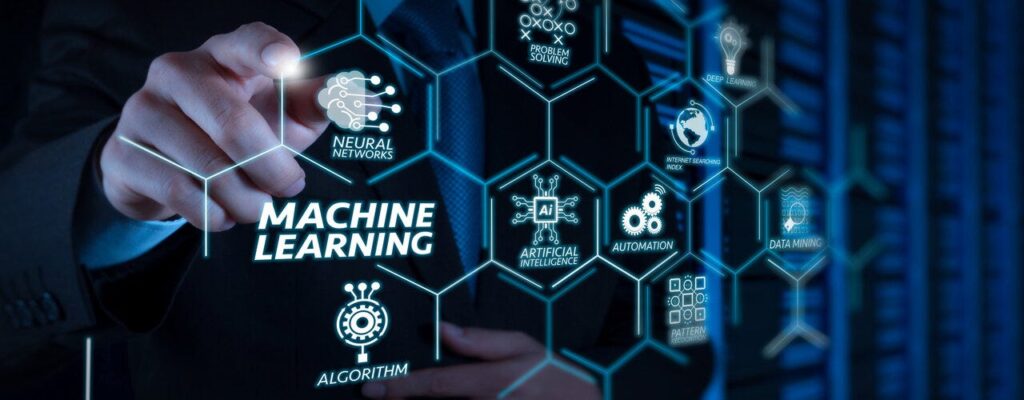
At its core, machine learning is a branch of artificial intelligence (AI) that enables computers to learn and make decisions without being explicitly programmed for every single task.
Think of it like this:
- Traditional Programming: You give the computer strict rules (a program) and input data. The computer follows the rules to produce an output.
- Example: You program a calculator with the rule “a + b = c.” You input
2and3, and it outputs5. It can’t do anything else.
- Example: You program a calculator with the rule “a + b = c.” You input
- Machine Learning: You give the computer input data and the desired outputs. The computer’s job is to figure out the rules (or “patterns”) that connect the data to the outputs.
- Example: You show the computer thousands of pictures of cats and dogs, each labeled “cat” or “dog.” After analyzing all this data, the machine learns the patterns that define a “cat” (pointy ears, whiskers) and a “dog” (floppy ears, longer snout). Once trained, you can show it a new, unlabeled picture, and it will correctly identify the animal.
In essence, machine learning is about pattern recognition and prediction. It’s the science of getting computers to act without being explicitly programmed, by learning from data.
The Official Definition
The field’s pioneer, Arthur Samuel, defined it in 1959 as the “field of study that gives computers the ability to learn without being explicitly programmed.” This remains the perfect, simple explanation of what machine learning is.
How Does Machine Learning Work? The 3-Step Process
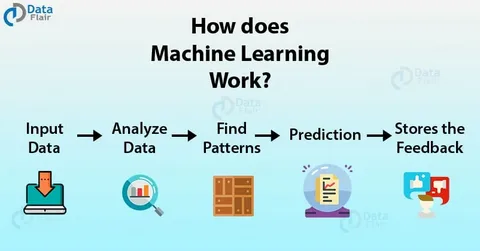
While the algorithms can be complex, the overall process of machine learning is surprisingly straightforward. It typically involves three key stages:
1. Input: The Training Data
This is the foundation. You feed the machine learning model a large amount of historical data. This data can be anything: numbers, photos, text, audio clips, or sales figures. The quality and quantity of this data are crucial—garbage in, garbage out.
2. Processing: The Learning Algorithm
This is the “brain” of the operation. An algorithm (a set of statistical rules) processes the training data to find patterns, correlations, and relationships. It continuously adjusts its internal parameters to minimize errors, slowly improving its ability to make accurate predictions. This is the “learning” phase.
3. Output: The Model & Predictions
After processing the data, the result is a “model.” This model is a trained program that encapsulates the learned patterns. You can then feed this model new, unseen data, and it will generate an output: a prediction, a classification, or a decision.
| Step | Component | Simple Analogy |
|---|---|---|
| 1. Input | Training Data | Showing a student thousands of solved math problems. |
| 2. Processing | Learning Algorithm | The student studying the problems, identifying the methods and formulas used to solve them. |
| 3. Output | Trained Model | The student, who is now prepared to solve new, similar math problems on their own. |
The 3 Main Types of Machine Learning (With Everyday Examples)
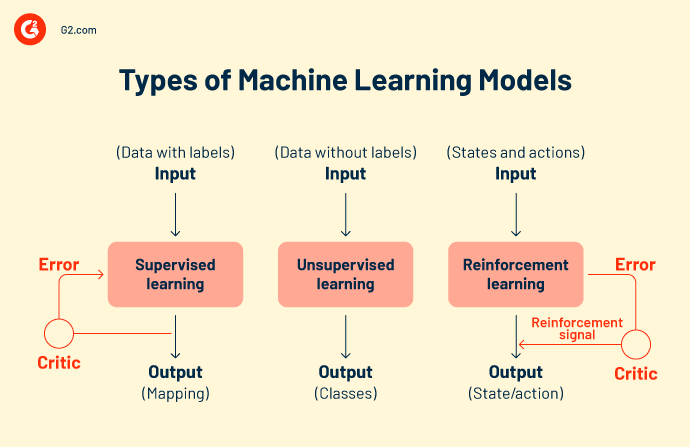
To truly grasp what machine learning is, you need to understand its primary learning styles. They are distinguished by how the algorithm “learns” from data.
1. Supervised Learning: Learning with a Teacher
This is the most common type. Here, the training data is labeled. Think of it as learning with an answer key.
- How it works: The algorithm is given input data along with the correct output. Its goal is to learn a general rule that maps inputs to outputs.
- Common Tasks: Classification (categorizing data) and Regression (predicting a continuous value).
- Real-World Example:
- Spam Filtering: Your email provider shows the algorithm millions of emails, each pre-labeled as “spam” or “not spam.” The algorithm learns the patterns (specific words, sender addresses) associated with spam. When a new email arrives, the model can accurately predict whether it’s spam.
- Weather Prediction: The model is trained on historical weather data (input: humidity, pressure, wind speed) and the actual recorded temperature (labeled output). It learns to predict future temperatures based on new weather data.
2. Unsupervised Learning: Finding Hidden Patterns
Here, the training data is unlabeled. The algorithm is left to its own devices to find structure and relationships within the data—there is no “teacher” or answer key.
- How it works: The algorithm identifies inherent groupings, clusters, or associations in the data.
- Common Tasks: Clustering and Association.
- Real-World Example:
- Customer Segmentation: A retailer feeds customer purchase data (unlabeled) into an algorithm. The algorithm might identify distinct clusters: one group that buys diapers and beer (a classic data mining discovery), another that buys organic food and yoga mats, etc. The company can then target these groups with specific marketing campaigns.
- Recommendation Systems (partially): Services like Spotify or Netflix use unsupervised learning to group users with similar listening/watching habits. If you like Band A, and Users in your cluster also like Band B, the system will recommend Band B to you.
3. Reinforcement Learning: Learning by Trial and Error
This type mimics how humans learn. An “agent” learns to make decisions by performing actions in an environment to maximize a cumulative reward.
- How it works: The algorithm (agent) interacts with a dynamic environment. It tries different actions, receives rewards for good actions and penalties for bad ones, and over time learns the optimal strategy (policy) to achieve its goal.
- Common Tasks: Game playing, robotics, resource management.
- Real-World Example:
- A Self-Driving Car: The car (agent) is in an environment (the road). It tries actions like accelerating, braking, or turning. It gets a positive reward for staying in its lane and a massive negative reward (penalty) for crashing. Through millions of simulations, it learns the safest and most efficient way to drive.
- AlphaGo: The AI that beat the world champion in the complex game of Go learned by playing millions of games against itself, reinforcing winning strategies.
Machine Learning in Your Daily Life: 7 Powerful Examples
You now understand what machine learning is conceptually. But where do you actually see it? The answer is: everywhere.
- Voice Assistants: Siri, Alexa, and Google Assistant use ML for speech recognition (converting your words to text) and Natural Language Processing (understanding what you mean).
- Face Recognition: Your phone’s Face ID and Facebook’s photo tagging use ML models trained on millions of faces to uniquely identify you.
- Navigation & Traffic Apps: Google Maps and Waze use ML to analyze real-time and historical location data from users to predict traffic conditions and estimate your arrival time.
- Product Recommendations: “Customers who bought this also bought…” on Amazon is a classic example of a recommendation engine powered by ML.
- Fraud Detection: Your bank’s fraud department uses ML to analyze your spending patterns. If a transaction doesn’t fit your profile (e.g., a large purchase in a foreign country), the system flags it as suspicious.
- Medical Diagnosis: ML models can analyze medical images (X-rays, MRIs) to detect diseases like cancer with a high degree of accuracy, often assisting radiologists.
- Dynamic Pricing: Ride-sharing apps like Uber and Lyft, and airline websites, use ML to adjust prices in real-time based on demand, supply, and other market factors.
Getting Started with Machine Learning
Feeling inspired? The field of machine learning is vast and accessible. Here’s a simple path to begin your own journey:
- Build a Foundation: Start with basic mathematics (linear algebra, calculus, statistics) and learn Python, the most popular programming language for ML.
- Learn the Concepts: Dive deeper into the core algorithms and theory through online courses (Coursera, edX) or textbooks.
- Practice with Tools: Get hands-on with user-friendly libraries like
scikit-learnfor traditional ML and platforms likeKaggleto compete in real-world data science challenges. - Build a Project: The best way to learn is by doing. Start with a simple project, like building a model to predict house prices or classify different types of flowers.
Conclusion: The Future is a Learning Machine
So, what is machine learning? It’s not a mysterious black box or a distant sci-fi concept. It’s a powerful, practical tool that allows computers to learn from experience, turning raw data into intelligent action.
From the moment you wake up and check your phone to the time you stream a movie at night, you are interacting with machine learning. It is the invisible engine driving much of the modern digital world’s personalization, efficiency, and innovation.
As a beginner, you’ve now taken the first and most important step: understanding the fundamental what, how, and why. The next step is to explore, experiment, and perhaps even contribute to this incredibly transformative field.



GIPHY App Key not set. Please check settings