Imagine a world where diseases are predicted before symptoms appear. Where treatments are perfectly tailored to your unique biology. This is not science fiction. It’s the new reality of Machine Learning in Healthcare.
By turning complex medical data into life-saving insights, ML is transforming patient care. It’s helping doctors diagnose with stunning accuracy, discover new drugs faster, and create personalized treatment plans.
This guide cuts through the technical jargon. We’ll show you exactly how Machine Learning in Healthcare is creating a healthier future for everyone.
What is Machine Learning in Simple Terms?
Think of Machine Learning as a super-smart assistant for doctors.
- It learns from experience. We feed computers vast amounts of medical data—like X-rays, health records, and DNA sequences.
- It finds hidden patterns. The ML algorithm analyzes this data to learn what a disease looks like or which treatment works best.
- It helps doctors decide. It gives clinicians powerful insights, helping them make faster, more accurate decisions.
The goal is simple: augment human expertise, not replace it. ML handles the data-heavy work, freeing up doctors for patient care.
Read more about YouTube Automation with ML for Free: The 2025 Definitive Guide
5 Ways Machine Learning is Transforming Medicine Today
ML isn’t a future dream. It’s already in clinics and hospitals, making a real difference.
1. Smarter Medical Scans: An AI Assistant for Radiologists
ML algorithms are now expert partners in analyzing medical images. They act as a second pair of eyes that never gets tired.
Here’s what they can do:
- Spot early-stage cancer in mammograms and lung CT scans, often catching subtle signs humans might miss.
- Diagnose eye diseases like diabetic retinopathy from retinal scans, preventing blindness.
- Identify brain abnormalities linked to strokes or Alzheimer’s disease in MRI scans.
The result? Earlier detection, fewer missed diagnoses, and better patient outcomes
2. Faster Drug Discovery: Shortening a 10-Year Journey
Developing a new drug is slow and incredibly expensive. ML is speeding it up.
How it helps:
- Finds New Targets: ML scans genetic data to find new biological targets for drugs.
- Screens Molecules Virtually: It predicts how thousands of drug compounds will behave, saving years of lab work.
- Improves Clinical Trials: Algorithms can identify the best patients for a trial, making the process more efficient.
This means life-saving treatments can reach patients much faster.
3. Personalized Medicine and Genomics: Tailoring Treatment to You
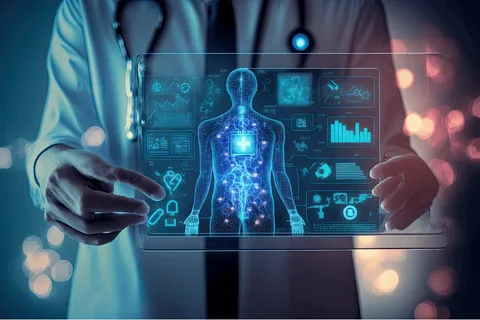
The “one-size-fits-all” approach to medicine is becoming obsolete. ML is the engine behind personalized medicine, which aims to tailor medical treatment to the individual characteristics of each patient.
- Genomic Analysis: Sequencing a human genome produces a massive dataset. ML algorithms can sift through this data to identify genetic mutations linked to specific diseases, predict an individual’s risk for certain conditions, and determine the most effective therapies based on their genetic makeup.
- Optimizing Treatment Plans: By analyzing data from thousands of similar patients, ML can help clinicians select the best drug, dosage, or treatment protocol (e.g., in oncology) for a new patient, maximizing efficacy and minimizing adverse effects.
4. Predictive Analytics and Early Warning Systems
Hospitals are using ML-powered predictive analytics to move from reactive to proactive care.
- Early Sepsis Detection: Sepsis is a life-threatening condition that requires rapid intervention. ML models can continuously analyze patient vital signs and lab results from the EHR to identify early, subtle signs of sepsis hours before it would be clinically obvious, triggering alerts to the care team.
- Hospital Readmission Reduction: Algorithms can predict which patients are at high risk of being readmitted to the hospital after discharge, allowing care teams to provide targeted support, such as additional follow-ups or patient education, to prevent it.
- Deterioration Prediction: Systems like the Epic Deterioration Index (EDI) use ML to give clinicians a risk score for patient deterioration, helping them prioritize care and intervene before a crisis occurs.
5. Administrative Automation and Operational Efficiency
Beyond clinical care, ML is streamlining the administrative burdens that weigh down healthcare systems.
- Coding and Billing: Natural Language Processing (NLP), a branch of ML, can automatically read clinical notes and accurately assign medical codes, reducing errors and administrative overhead.
- Appointment Scheduling and Triage: Chatbots and virtual assistants can handle initial patient interactions, schedule appointments based on urgency, and answer common questions, freeing up staff for more complex tasks.
Real-World Case Studies and Data
- Google Health’s AI for Breast Cancer Detection: A 2020 study published in Nature showed that their AI model outperformed human radiologists in identifying breast cancer in mammograms, reducing false positives by 5.7% and false negatives by 9.4%.
- Stanford’s AI for Skin Cancer: An ML model developed at Stanford achieved performance on par with 21 board-certified dermatologists in classifying skin lesions from images, making expert-level diagnosis accessible via a smartphone app.
- The UK’s NHS and DeepMind: The partnership developed an AI that can analyze 3D retinal scans for over 50 sight-threatening diseases with 94% accuracy, matching world-leading eye experts.
Challenges and The Future: Responsible Integration
Despite its immense potential, the integration of Machine Learning in Healthcare faces hurdles:
- Data Quality and Availability: ML models are only as good as the data they’re trained on. Biased or incomplete data can lead to biased algorithms.
- Regulatory Hurdles: Ensuring patient safety is paramount. Agencies like the FDA are developing robust frameworks for approving AI-based medical devices.
- The “Black Box” Problem: Some complex ML models are difficult to interpret, making it hard for doctors to trust a diagnosis without understanding the “why.”
- Clinical Workflow Integration: For ML to be effective, it must be seamlessly integrated into existing clinical workflows, not added as a separate, cumbersome step.
The future lies in explainable AI (XAI) to build trust, federated learning to train models on data without compromising privacy, and a continued focus on human-AI collaboration.
Conclusion: A Paradigm Shift is Underway
Machine Learning in Healthcare is more than a technological trend; it is a fundamental paradigm shift. By harnessing the power of data, we are entering an era of medicine that is more precise, predictive, and personal than ever before. While challenges remain, the ongoing collaboration between data scientists, clinicians, and regulators is paving the way for a healthier future for all—a future where data-driven insights are a standard tool in the life-saving toolkit of medicine.
Leave a Reply