

 Saba Khalil
You finish a movie and Netflix instantly suggests your next binge. You wake up on a Monday to a brand-new, perfectly curated Spotify playlist. This isn’t magic. It’s machine learning in action.
Netflix and Spotify are two of the world’s most prominent examples of companies that have leveraged AI and machine learning not just as a feature, but as their core business model. Their sophisticated algorithms have fundamentally changed how we discover and consume entertainment.
This article is a deep dive into how Netflix and Spotify use machine learning. We’ll move beyond the surface-level “recommendation engine” explanation to explore the complex, multi-layered AI systems that power personalization, content creation, and the entire user experience.
The Grand Challenge: Solving the Discovery Problem
Both Netflix and Spotify face the same fundamental business problem: an overwhelming amount of content.
- Netflix offers thousands of titles.
- Spotify boasts over 100 million tracks.
Presenting every option to a user is impossible. The goal, therefore, is to solve the “discovery problem” by connecting each user to the tiny fraction of content they will love most. This is where machine learning becomes their most powerful tool. The core principle is simple: Increased personalization leads to increased engagement, which leads to increased retention and revenue.
How Netflix Uses Machine Learning: More Than Just “Because You Watched”
Netflix’s ML strategy is a sophisticated ecosystem of interconnected models that work together from the moment you open the app.
1. The Recommendation Engine: A Multi-Armed Bandit
While often called a single algorithm, Netflix’s recommendation system is actually a complex ensemble of models. It doesn’t just rely on what you’ve watched.
- Personalized Video Ranking (PVR): This is the core model that generates your unique homepage. It doesn’t just recommend what you might like, but also prioritizes how to present those options. It analyzes:
- Your Explicit Feedback: Your ratings, thumbs up/down.
- Your Implicit Behavior: What you watch, when you stop watching, what you search for, what you rewatch.
- Contextual Data: Time of day, device you’re using (mobile vs. TV), and how long you’ve been a member.
- Similar Users: Collaborative filtering that finds “taste neighbors” and recommends what they liked.
The system is often described as a “multi-armed bandit” problem—constantly balancing the exploitation of known likes with the exploration of new content to improve its model of your tastes.
2. Artwork Personalization: The AI That Designs Your Thumbnails
This is one of Netflix’s most ingenious uses of ML. Did you know the artwork you see for a movie might be different from what your friend sees?
Netflix uses A/B testing and computer vision to determine which thumbnail image is most likely to make you click on a title.
- The Process: For a show like Stranger Things, Netflix might generate dozens of thumbnails—one focusing on the heroine Eleven, another on the Demogorgon, another on the group of kids.
- The AI: Machine learning models analyze which image drives the highest click-through rate for different user segments (e.g., horror fans vs. sci-fi fans vs. drama fans).
- The Result: You see the artwork that personally resonates with you, dramatically increasing the chance you’ll start watching.
3. Content Acquisition & Production: The Data-Driven Greenlight
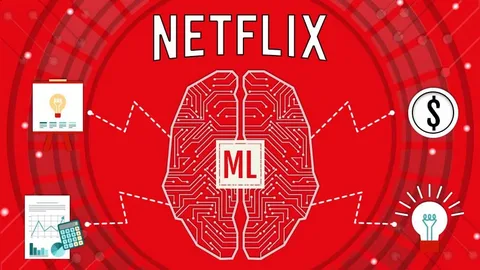
Netflix has famously used data to inform its multi-million dollar content decisions.
- Identifying Gaps: By analyzing viewing trends of existing licensed content, Netflix can identify untapped audience interests. The data showed a strong audience overlap between fans of David Fincher’s films, Kevin Spacey’s political dramas, and the British version of House of Cards—giving them the confidence to greenlight the expensive original series.
- Optimizing Production: ML algorithms can even analyze scripts to predict potential success and suggest elements that align with popular tropes or genres.
4. Streaming Quality: The AI That Prevents the Buffering Wheel
Using a technique called adaptive bitrate streaming, Netflix’s algorithms predict your network bandwidth in real-time. They automatically adjust the video quality to ensure smooth playback without buffering, providing the best possible experience without manual intervention.
Read More about The Role of Data in Machine Learning: It’s More Than Just Fuel
How Spotify Uses Machine Learning: The Maestro of Your Music
Spotify’s mission is to soundtrack your life by delivering the right audio at the right moment. Its ML infrastructure is a symphony of natural language processing, audio analysis, and collaborative filtering.
1. The Magic of Discover Weekly & Release Radar
Your weekly personalized playlists are the crown jewels of how Spotify uses machine learning. They are built on three primary models, often called the “Three-Layered Approach”:
- Collaborative Filtering: The foundational model. It analyzes billions of user-created playlists to find “song neighbors.” If users who like Song A also have Song B in their playlists, the algorithm infers a connection. This is the “collective intelligence” of the Spotify community.
- Natural Language Processing (NLP): Spotify continuously scrapes the web—news articles, blogs, forum posts, and even song lyrics—to understand the cultural context and descriptive language around music. It builds a “taste profile” for songs and artists using words like “chill,” “upbeat,” “jazz,” or “indie.”
- Raw Audio Analysis with Convolutional Neural Networks (CNNs): This is Spotify’s secret sauce. Instead of just relying on metadata, their models analyze the raw audio tracks themselves. A CNN can “listen” to a song and identify its musical characteristics—tempo, key, energy, danceability, and acousticness. This allows Spotify to make connections that are purely musical, beyond what is popular or well-documented.
The fusion of these three models creates a uniquely powerful and personalized recommendation engine.
2. AI DJ: The Personalized Radio Station
The AI DJ feature is the evolution of Spotify’s personalization. It uses generative AI (via OpenAI partnership) to synthesize a realistic voice that not only plays music but also provides commentary. The ML system here:
- Selects the songs based on your history and real-time feedback (hitting the “like” or “skip” buttons).
- Generates the script for the DJ’s commentary about the artist or album.
- Creates the DJ’s voice in a natural, dynamic way.
3. Podcast Recommendations: A New Frontier
As podcasting grows, Spotify applies similar ML techniques. It transcribes podcast audio to text, then uses NLP to understand the content, topics, and sentiment, allowing it to recommend podcasts much like it recommends music.
4. playlist Curation & Fresh Finds
Spotify uses ML to power its editorial playlists like “Fresh Finds,” which surfaces emerging artists before they become popular. The algorithm detects “hype” by analyzing the velocity at which unknown songs are being saved by listeners with a history of discovering hits early.
Netflix vs. Spotify: A Comparative Look at Their ML Strategies
| Feature | Netflix’s Primary Focus | Spotify’s Primary Focus |
|---|---|---|
| Core Data | Visual content (video), user watch-time | Audio content, user listening history, audio signals |
| Key ML Models | Collaborative filtering, computer vision, bandit algorithms | Collaborative filtering, NLP, Convolutional Neural Networks |
| Signature Output | Personalized homepage and title rows | Discover Weekly, AI DJ, Daily Mixes |
| Content Strategy | Data-informed greenlighting for original productions | Data-driven artist promotion and playlist curation |
The Impact: Why This All Matters
The sophisticated application of machine learning by Netflix and Spotify has created a powerful competitive advantage:
- Unbeatable User Engagement: By making discovery effortless, they keep users inside their ecosystems, reducing churn.
- Data-Driven Business Decisions: They minimize the risk of multi-million dollar investments in content.
- Creating a “Sticky” Product: The more you use them, the better they get, and the harder they are to leave. This creates a powerful network effect.
Conclusion: The Personalized Future of Entertainment
Understanding how Netflix and Spotify use machine learning reveals a fundamental shift in the entertainment industry. We have moved from a broadcast model, where everyone consumed the same thing, to a narrowcast model, where everyone’s experience is unique.
The algorithms are no longer just suggesting content; they are actively curating a personalized reality for each of us. As these models continue to evolve with advancements in generative AI and deep learning, the line between human curation and algorithmic discovery will blur even further, promising an future where your next favorite show or song is always waiting for you.




GIPHY App Key not set. Please check settings