
We live in a world drowning in data. From 4K video streaming and virtual reality to the ever-expanding Internet of Things (IoT), our demand for faster, more reliable wireless connectivity is insatiable. While 5G feels cutting-edge, it’s merely a stepping stone. The next great leap lies in a largely untapped region of the electromagnetic spectrum: the terahertz gap. Terahertz Communication, often called THz communication, is the frontier of wireless research, promising to revolutionize our digital world with speeds that make 5G look like dial-up.
Terahertz Communication, often called THz communication, is the frontier of wireless research, promising to revolutionize our digital world with speeds that make 5G look like dial-up. This article demystifies this emerging technology, exploring its profound potential, the significant hurdles it must overcome, and its role in shaping the 6G landscape.
What Exactly is Terahertz Communication?
To understand Terahertz Communication, we must first look at the radio spectrum. We are familiar with frequencies like MHz (FM radio) and GHz (Wi-Fi and 5G). The terahertz band occupies the space between microwave and infrared light, typically defined as frequencies from 0.1 THz to 10 THz.
Think of it this way: if today’s wireless signals are a garden hose, Terahertz Communication is a high-pressure firehose. It offers a massive amount of previously unused bandwidth. This vast, clean highway is the key to achieving terabit-per-second (Tbps) data rates—that’s up to 100 times faster than the peak speeds envisioned for 5G.
The Power of the Terahertz Band
This technology represents a paradigm shift. Instead of just improving what we have, it enables entirely new applications. It operates at a frequency so high that it begins to behave a little like light, allowing for extremely precise directional beams and unprecedented spatial reuse of the spectrum, meaning more devices can connect simultaneously without interference.
Read more about Metaverse in Healthcare: How Virtual Worlds Are Healing Real Patients
The Revolutionary Applications of THz Waves
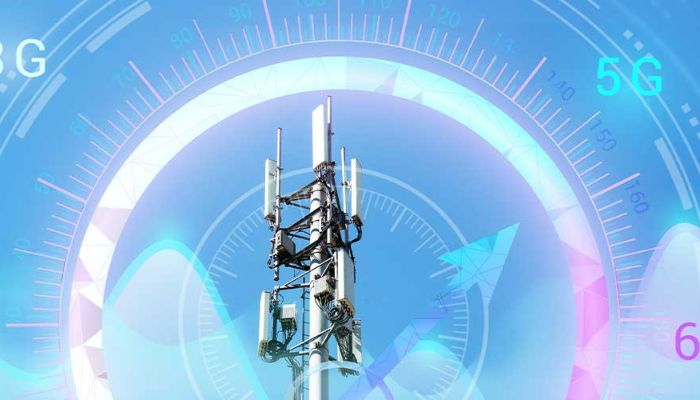
The potential applications of Terahertz Communication extend far beyond just downloading movies in a blink. Its unique properties will be the engine for next-generation technologies.
1. Wireless Terabit-Per-Second Networks
Imagine a world where physical cables between servers in data centers are obsolete. Terahertz Communication can provide fiber-optic-level speeds without the fiber, enabling instantaneous data backup, server synchronization, and ultra-dense cloud computing architectures. This same principle applies to kiosks and indoor hotspots, allowing for the seamless transfer of massive data volumes.
2. The Nervous System for Connected Intelligence
Autonomous vehicles, drones, and smart factories require an immense, instantaneous exchange of data. THz links can facilitate vehicle-to-everything (V2X) communication, allowing cars to share high-definition sensor and video data with each other and infrastructure in real-time, creating a collaborative and safer traffic environment.
3.Nano-Communication and the Internet of Nano-Things (IoNT)
This is one of the most futuristic applications. THz waves are ideal for communication between miniature devices, such as nanobots inside the human body for targeted drug delivery or internal health monitoring. These tiny devices could communicate with each other and external systems, opening up new frontiers in medicine and material science.
4. Advanced Imaging and Sensing with Terahertz Waves
Beyond pure communication, Terahertz waves have unique sensing capabilities. They can penetrate many non-conductive materials like clothing, paper, and plastics but are non-ionizing and safe, unlike X-rays. This makes them perfect for security screening, material characterization, and quality control in manufacturing.
The Inevitable Challenges of Terahertz Technology

The path to a Terahertz Communication future is not without its obstacles. The very properties that make it powerful also make it difficult to harness.
Overcoming Path Loss and Atmospheric Absorption
THz signals are highly susceptible to attenuation. They are easily absorbed by water vapor, oxygen, and even rain in the atmosphere. This means their range is inherently limited, making them best suited for short-range, indoor, or line-of-sight applications. A simple fog or heavy humidity can significantly degrade the signal.
The Hurdle of Component Design and Power
Creating the hardware for Terahertz Communication is a monumental challenge. We need new types of transmitters, receivers, and antennas that can operate efficiently at these extreme frequencies. Current components are often power-hungry, expensive, and not yet ready for mass production and consumer device integration.
The Road Ahead: Terahertz Communication and the 6G Future
Integrating THz technology into existing networks won’t be a simple plug-and-play operation. It will require a radical rethinking of network design, likely leading to ultra-dense networks of tiny, intelligent cells that can seamlessly hand off connections as users move.
The Road Ahead: Terahertz Communication and the 6G Future
The global research community is fully aware of these challenges, and progress is accelerating. Major universities, tech giants, and standards bodies are investing heavily in Terahertz Communication research.
Envisioning a Hybrid Network Ecosystem
The future 6G network will not rely solely on THz. Instead, it will be a smart, hybrid ecosystem. Your device might use sub-6 GHz for wide-area coverage, millimeter-wave for urban speed, and a Terahertz band link when you need an extreme, short-range data burst—all managed seamlessly by an intelligent network core.
The Timeline for Commercial THz Deployment
While active research and prototyping are underway, mainstream commercial deployment of Terahertz Communication is not expected until the 2030s, aligning with the anticipated rollout of 6G networks. This timeline allows for the necessary breakthroughs in material science, semiconductor technology, and international spectrum regulation.
Conclusion: The Invisible Highway of Tomorrow
Terahertz Communication is more than just an incremental upgrade; it is the key that unlocks a truly wireless, hyper-connected world. While significant technical hurdles remain, the potential reward—a society transformed by instant, massive data exchange—is too great to ignore. By overcoming the challenges of the terahertz gap, we are not just building faster phones; we are laying the invisible foundation for the next digital revolution, paving the way for 6G and technologies we have yet to imagine. The secret world beyond 5G is one of immense speed and possibility, and it’s waiting in the terahertz spectrum.
Leave a Reply