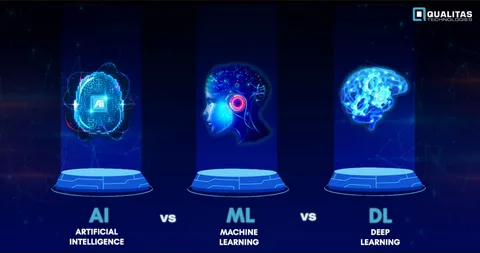
Understanding the difference between Machine Learning vs Artificial Intelligence is key to navigating today’s tech world. These terms are often used interchangeably, creating confusion. This guide will clearly explain the key differences between Machine Learning and Artificial Intelligence, and where Deep Learning fits in. We’ll use simple language and clear examples to make it all easy to understand.
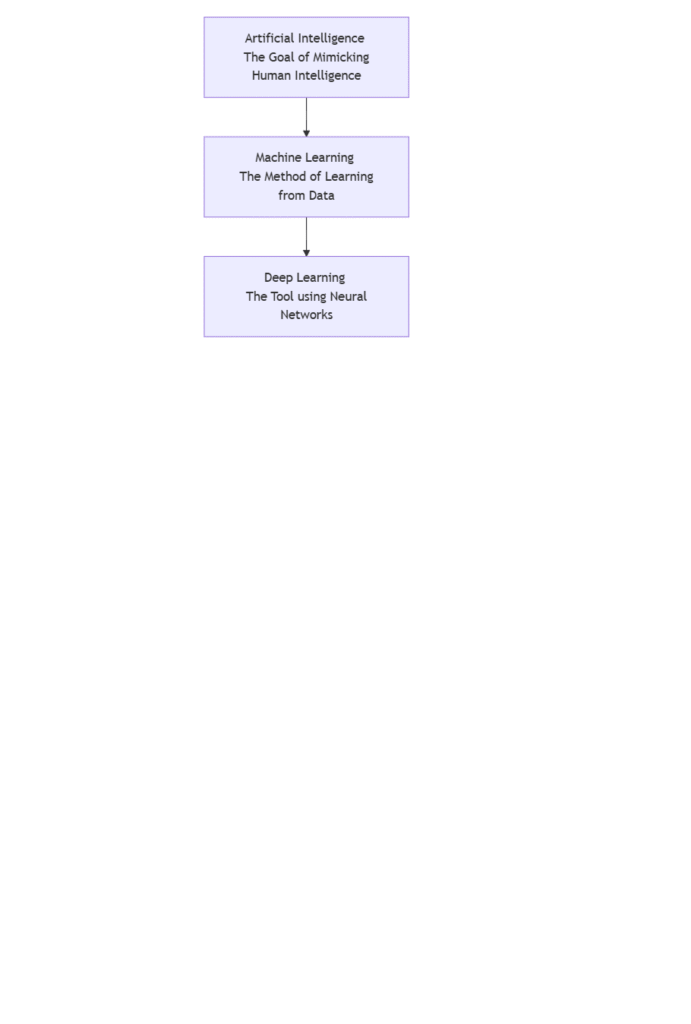
Let’s start with the core idea: Artificial Intelligence (AI) and Machine Learning (ML) are not the same thing. Think of them as a set of nesting dolls:
- Artificial Intelligence (AI) is the big, outer doll.
- Machine Learning (ML) is the medium doll inside AI.
- Deep Learning (DL) is the smallest, most specialized doll inside ML.
One contains the other. It’s a hierarchy of intelligence and specialization.
Now, let’s open each doll and see what’s inside.
What is Artificial Intelligence (AI)?
Artificial Intelligence is the broad science of creating intelligent machines. The goal of AI is to build systems that can perform tasks that typically require human intelligence.
This includes reasoning, problem-solving, understanding language, and learning. Artificial Intelligence can be achieved through various methods, including rule-based systems where programmers define all the logic.
Simple Analogy: A chess computer from the 1990s. It followed pre-programmed rules to decide its moves. It demonstrated Artificial Intelligence, but it couldn’t learn new strategies on its own.
Key Takeaways:
- AI is the overarching field.
- Its goal is to create smart machines.
- It can be rule-based and doesn’t always need to learn.
What is Machine Learning (ML)?
So, where does Machine Learning fit into the Artificial Intelligence landscape? Machine Learning is a specific approach to achieving AI.
Instead of hand-coding all the rules, we give the computer data and let it learn the rules for itself. This is the fundamental shift in the AI vs Machine Learning dynamic.
Think of it like this:
- Traditional AI Programming: You input the rules + data to get an answer.
- Machine Learning: You input the data + answers to get the rules.
The “rules” that the machine learns are called a model.
Why is ML a Game-Changer?
It allows computers to tackle problems too complex for human rule-writing.
For example, how would you write rules to identify a cat in a picture? It’s nearly impossible. But an ML model can learn to do it by analyzing thousands of cat photos.
Key Takeaway: ML is the dominant method for creating modern AI because it learns from data.
What is Deep Learning (DL)?
Deep Learning is a specific, advanced type of Machine Learning.
It allows computers to tackle problems too complex for human rule-writing. For example, writing rules to identify a cat in a picture is nearly impossible. But a Machine Learning model can learn to do it by analyzing thousands of cat photos.
Key Takeaway: Machine Learning is the dominant method for creating modern Artificial Intelligence because it learns from data.
Read More about How to Earn Money from Machine Learning in 2025 (Zero Investment Required)
The Power of Deep Learning in AI
- Power: It achieves state-of-the-art performance on complex tasks like image recognition and natural language processing (e.g., ChatGPT).
- Cost: It requires massive amounts of data and significant computing power.
Quick Comparison Table
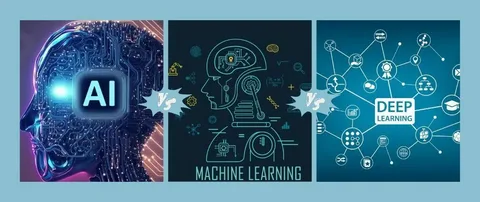
Let’s look at them side-by-side.
| Aspect | Artificial Intelligence (AI) | Machine Learning (ML) | Deep Learning (DL) |
|---|---|---|---|
| Relationship | The overarching field | A subset of AI | A subset of ML |
| Core Idea | Mimic human intelligence | Learn from data | Learn using neural networks |
| Data Needs | Varies (can be rule-based) | Needs data to learn | Needs huge amounts of data |
| Human Effort | High for rule-based systems | Needs guidance on features | Learns features automatically |
| Example | Chess program, simple chatbot | Spam filter, recommendation engine | Self-driving cars, facial recognition, ChatGPT |
A Real-World Example: Self-Driving Cars
Let’s tie it all together with a modern example.
- The AI Goal: Create a car that can drive intelligently and navigate a city.
- The ML Method: Instead of programming rules for every scenario, we train the car’s systems with millions of miles of real driving data. The car learns how to drive.
- The DL Tool: The car’s computer uses deep learning neural networks to process raw data from its cameras. It automatically learns to identify a pedestrian, a stop sign, or another car—all without a human defining those objects.
Conclusion: Clarity Achieved
So, the next time you hear these terms, remember this simple hierarchy:
- AI is the ultimate goal of creating intelligent machines.
- ML is the primary way we are achieving that goal by using data.
- DL is a powerful technique supercharging ML, especially for complex data like images and language.
Understanding this relationship is key to cutting through the hype and truly appreciating the technology shaping our world.
Leave a Reply